
Raja Aziz Bhatti Shaheed
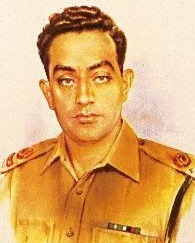 Major Raja Aziz Bhatti 6 August 1928– 10 September 1965), born as Raja Aziz Bhatti in Gujrat , was a military officer in the Pakistan Army who was cited with the Nishan-e-Haider (Eng. Lit.: Emblem of Lion) for his actions of valor during the Battle of Burki in second war with India in 1965.From January 1965 till May 1965, Maj. Bhatti served as the General Staff Officer (GSO) of the 17th Punjab Regiment, but was later posted as the commander of the two military companies after the Indian Army's launching the invasion by crossing the international borders in September of 1965. Leading the military companies, Maj. Bhatti was initially deployed on the forward positions of the BRB Canal near the Burki area that falls in the vicinity of the Lahore District in Pakistan-side Punjab. On 10 September 1965, Maj. Bhatti was on a routine when he stood up from his trench to observe the enemy position despite being warned by army sergeant to take cover and move out of the target– the advise was unheeded by Maj. Bhatti and justified his actions of taking a better view of before order the artillery of targeting the Indian Army's armory. Maj. Bhatti was eventually hit by the tank shell on the shoulder and was killed in an impact on instant. Maj. Bhatti was 37 years old at the time of his death. Maj. Aziz Bhatti was buried in the courtyard of his ancestral home at Ladian, a small village of Gujrat, Punjab in Pakistan. In 1966, the federal government accepted the recommendations and announced to posthumously award the Nishan-e-Haider for his gallant and actions of valor during the defense of the Burki.
Major Muhammad Akram Shaheed
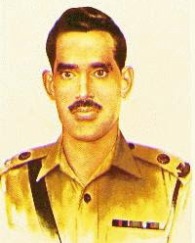 Muhammad Akram belongs to Dinga, a small City in Gujrat District,he belongs to Malik Awan family. He was born on 4 April 1938. He was a military brat and his father, Malik S. Muhammad, was an enlisted personnel in the British Army who later retired as a Havildar, an army sergeant, in the Pakistan Army. After securing his graduation from a local middle school in Nakka Kalan, Akram entered to join the Military College Jhelum– an ROTC and an army's OCS in Jhelum, Punjab. In 1959, Muhammad Akram was invited to attend the Pakistan Military Academy but only spent a semester after being deployed in East-Pakistan as a Corporal.He received commission in the Army through his years of attendance at the army's OCS in Jhelum in 1961, and was attached to the East Pakistan Rifles as a military advisor in 1963 till 1965. In 1965, Capt. Akram was stationed in different parts of the West-Pakistan before being deployed in East-Pakistan as a quartermaster with the Frontier Force Regiment till 1967–68. In 1968–70, Maj. Akram served with the 4th battalion posted with the Frontier Force Regiment, eventually becoming its commanding officer by 1971.During the east Pakistan War of 1971, the 4th FF Regiment, which at that time was commanded by then Col. Muhammad Mumtaz Malik, was placed in the forward area of the Hilli Municipality (under Hakimpur Upozila, Dinajpur District), in what was then East Pakistan. The regiment came under continuous and heavy air, artillery and armour attacks from the Indian Army. Despite enemy superiority in both numbers and firepower, Akram and his men repulsed many attacks, inflicting heavy casualties on the enemy. He was killed in action in the attack and was posthumously awarded the Nishan-e-Haider, Pakistan's highest military honour.
Major Shabbir Sharif Shaheed
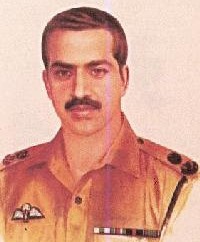
He was commissioned in Pakistan Army on 19 April 1961 and after successfully completing his training, after which he was awarded the Sword of Honor, he was posted to the 6th Battalion of the Frontier Force Regiment. In the Indo-Pakistani War of 1971, the Pakistan Army launched an offensive on the Western front against the enemy. Sharif, as commander of a company of 6 Frontier Force Regiment, was ordered to capture high ground overlooking Grumukhi Khera and Beri, a village in the Sulemanki Sector.On 3 December 1971, in a well-organised action, he fought alongside his men and held Indian attacks at bay. He cleared the Jhangar post by passing through the minefield laid by enemy and swimming across a water obstacle, the 'Sabuna distributary', whilst under intense enemy fire and led his company to capture the objective.On the afternoon of 6 December, the enemy launched an offensive preceded by air strikes and heavy artillery shelling. After casualties amongst the crew, he took over as a gunner on an anti-tank gun and started firing on the enemy tanks. While this fight was on, one of the enemy tanks fired at him thus killing him. His last words were quoted as: “Don’t lose the bridge.” It was the same bridge he died defending from the enemy's attack.
Chaudhry Zahoor Elahi
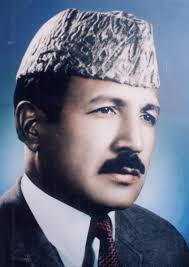 Chaudhry Zahoor Elahi (1921-25 September 1981) was a Pakistani politician who rose to prominence from a small town of Gujrat, Punjab, Pakistan.Chaudhry Zahoor Elahi began his career in the police force as a constable but gave it up soon after the creation of Pakistan and ventured into business in association with his elder brother Ch. Manzoor Elahi, who was a textile engineer by profession. The two brothers jointly purchased and operated a textile mills after independence of Pakistan in Gujrat. Chaudhry Zahoor Elahi was a Jat of the Warriach clan. He entered local politics in the 1950s. During Ayub Khan's rule. During this period, the governor of West Pakistan, Nawab of Kalabagh Amir Mohammad Khan, was opponent of Chaudhry Zahoor Elahi. As the Secretary-General of the Convention Muslim League, he came to oppose Zulfikar Ali Bhutto. In his conflict with Bhutto, Chaudhry Zahoor Elahi was imprisoned and his family property was confiscated by the Government. Chaudhry Zahoor Elahi was assassinated in Lahore in 1981 by al-Zulfikar, a terrorist organisation led by Murtaza Bhutto, who claimed responsibility for the attack.
Chaudhry Shujaat Hussain
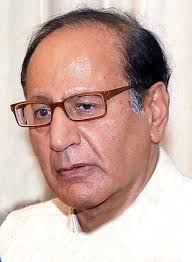 Chaudhry Shujaat Hussain born 27 January 1946) is a senior Pakistani conservative politician hailing from Gujrat and a business oligarch who previously served as 16th Prime Minister of Pakistan from 30 June 2004 on a temporary basis during a transitional period to accommodate Shaukat Aziz till 28 August 2004. Hussain has been party president of the Pakistan Muslim League (Q) since 2003, ,Shujaat Hussain graduated from the FC College University and the Punjab University. After his graduation, Hussain subsequently joined the family business comprising large numbers of industries, textiles, agricultural farms, sugar and flour mills. He successfully contested in the non-partisan 1985 elections and was appointed as minister of industry in the government of Prime minister Muhammad Junejo, lasting until 1988. Hussain became a leader and influential conservative figure in the Islamic Democratic Alliance (IDA) between 1988 and 1990 and joined the Pakistan Muslim League (PML).
Chaudhry Pervaiz Elahi
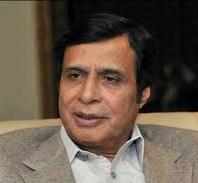 Chaudhry Pervaiz Elahi born 1 November 1945) is a Pakistani politician who is the current Speaker of the Provincial Assembly of the Punjab, in office since August 2018. He has been a member of the Provincial Assembly of the Punjab since August 2018.He served as the first and only Deputy Prime Minister of Pakistan in 2013. After a successful campaign in the 2002 general elections, he became the Chief Minister of Punjab Province and tenured until 2007. In 2008, he served as the leader of the opposition in the National Assembly of Pakistan for short time. He was a member of the National Assembly from 2008 to May 2018.He was re-elected to the National Assembly as a candidate of PML-Q from Constituency NA-65 and NA-69 in 2018 Pakistani general election. In the same election, he was re-elected to the Provincial Assembly of Punjab as a candidate of PML-Q from Constituency PP-30 (Gujrat-III). Following his successful election, he abandoned his national assembly seats in favor of the provincial assembly seat.[20] He was named by Pakistan Tehreek-e-Insaf (PTI) and PML-Q as their joint candidate for the office of Speaker of the Provincial Assembly of Punjab. On 16 August 2018, he was re-elected as Speaker of the Punjab Assembly. He received 201 votes against his opponent Muhammad Iqbal Gujjar who secured 147 votes.